5 Signs Your Garage Door Spring Is About to Fail
Springs do the real lifting on your garage door — the opener just steers. And like anything that flexes thousands of times, they wear out on a schedule. The good news: a dying spring usually warns you first.
First, why springs fail at all
Most residential torsion springs are rated for about 10,000 cycles — one cycle being one open and close. If your household opens the door six times a day (school runs, work, deliveries, the dog), that's over 2,000 cycles a year. Builder-grade springs on a busy Katy garage can be near end-of-life in five to seven years, even faster when Gulf-coast humidity gets a rust foothold on the coils.
Here's what to watch — and listen — for.
1. The door suddenly feels heavy
A healthy door is balanced: pull the opener's red release cord (with the door fully closed), lift the door halfway by hand, and let go. It should hover in place. If it slams down or takes real muscle to lift, the springs are no longer carrying the weight — they've stretched, weakened, or one of a pair has already quietly failed.
2. A loud bang from the garage
The classic. A torsion spring lets go all at once, and the stored energy makes a sound homeowners routinely mistake for a break-in or a firecracker. If you heard a bang and now the door won't lift, don't keep pressing the opener button — you'll strip the trolley or bend the top panel. That's a spring replacement, and it's usually a same-day fix.
3. A visible gap in the spring
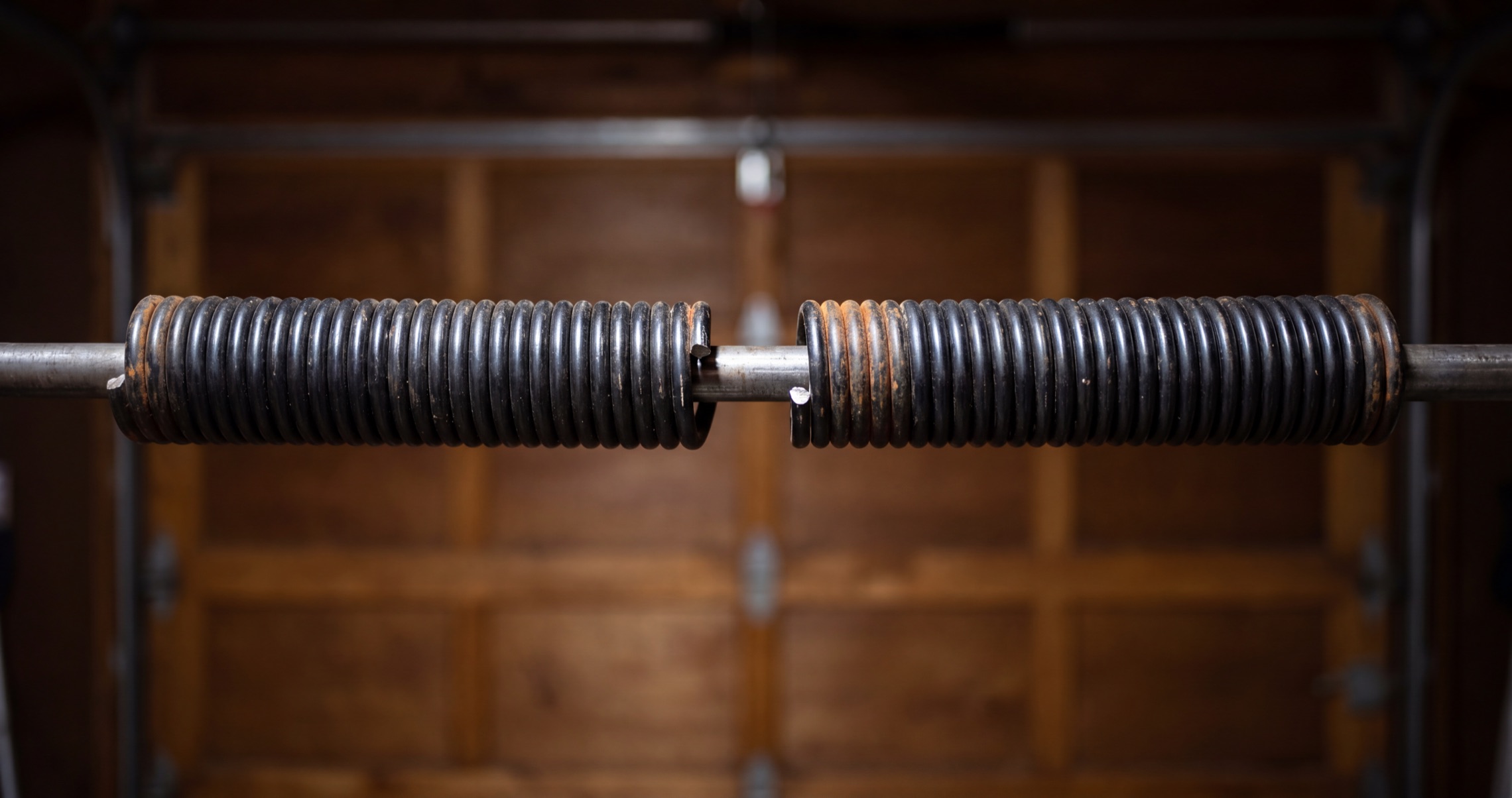
Look above the door at the horizontal spring on the shaft (door closed, from a safe distance). A healthy torsion spring is one tight, continuous coil. A snapped one shows a clean 2–3 inch gap where the coils have sprung apart. This one's binary: gap means broken, no exceptions.
4. The door lifts crooked or shakes
On two-spring doors (and older extension-spring setups with one spring per side), a weak side makes the door climb unevenly, jerk, or look tilted in the opening. Cables can slip their drums when tension goes lopsided — which turns a spring job into a spring-and-cable job the longer it runs.
5. Rust, stretch marks, and squeal
Rust pits the steel and accelerates coil fatigue — a real issue in our humidity. Coils that look stretched or uneven, or a spring that squeals and grinds even after a light coat of garage-door lubricant, are telling you they're tired. (Season-by-season rust prevention is covered in our Texas maintenance checklist.)
What to do if you spot these signs
Stop using the door if it's visibly broken, crooked, or slamming — every extra cycle risks the cables, panels, and opener. Then send us a request with your neighborhood and a photo of the spring if you can get one safely. We replace springs with high-cycle hardware, balance the door, and safety-test it — 24/7 if a car is trapped.
Caught it early? Ask for a tune-up instead — tightening, lubrication, and a balance check costs a fraction of the repairs a neglected spring causes.